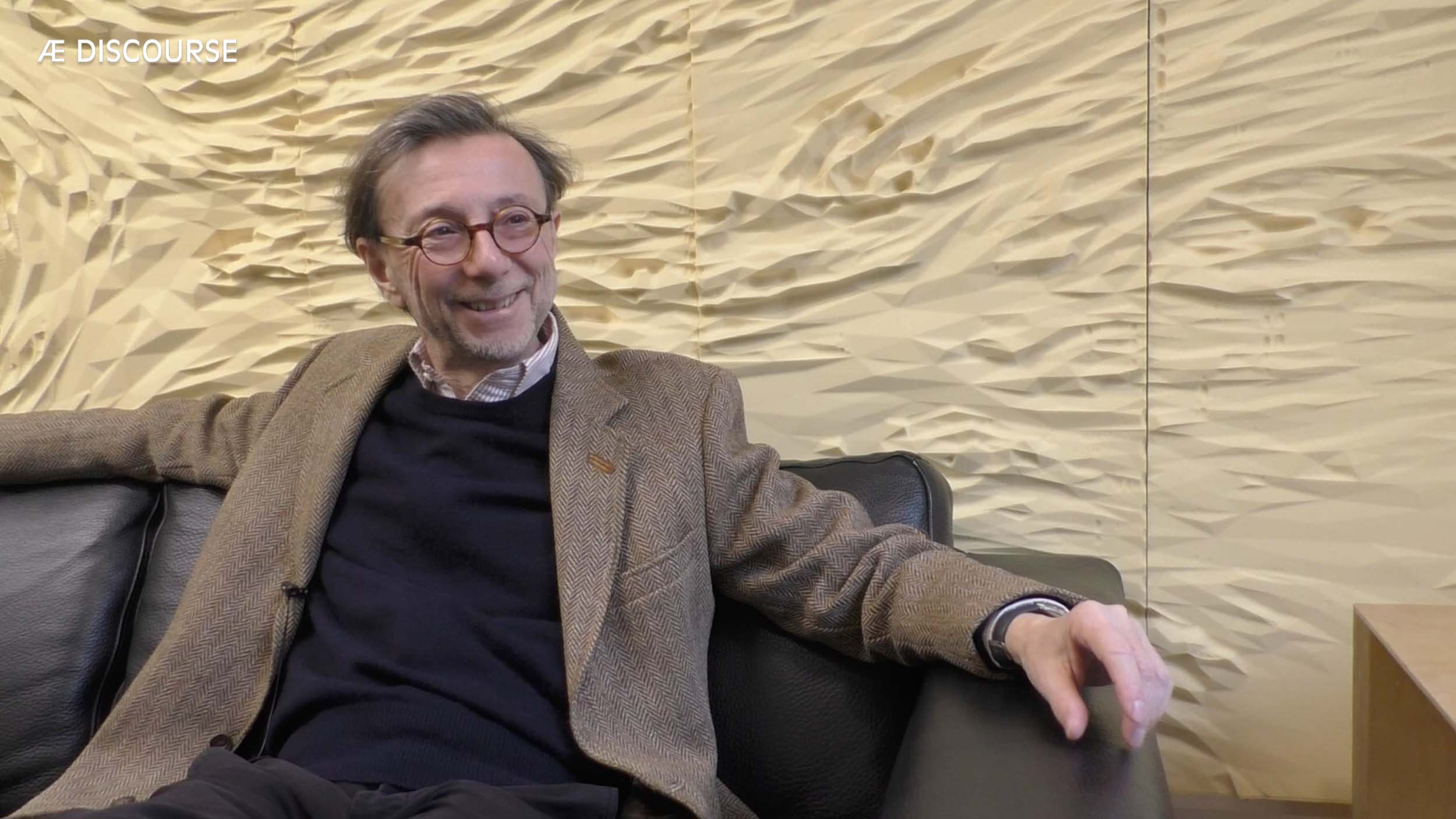
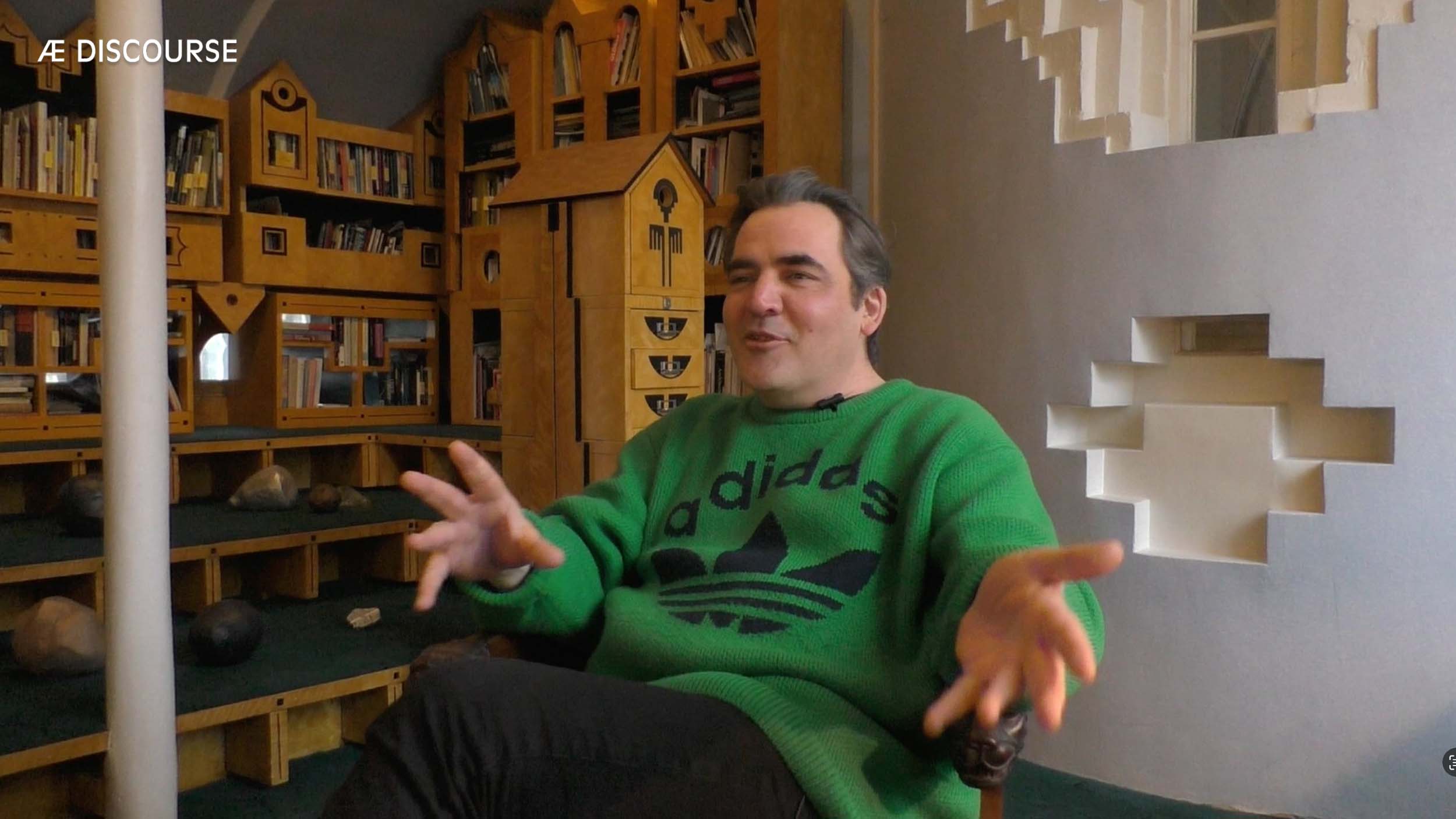
Nigel Coates
Biographical interview
SUMMARY
In this interview, Nigel Coates discussed his trajectory from studying and teaching with Bernard Tschumi at the AA, to founding NATO and later Branson Coates, and eventually becoming head at the Royal College of Art. The conversation focused on the unique sensibility that informs his work, which synthesizes influences from Italy, Merleau-Ponty’s Phenomenology of Perception, performance art, postmodernism, transavantgarde painting, punk, nightclub culture, and queer culture.
Although his influences might appear eclectic, Coates explained that a consistent argument underpins his work: bodily presence, sensuality, richness, concreteness, and urbanity carry critical and political significance. His approach challenged the blandness of 1960s architecture experienced as an undergraduate at Nottingham University, the sanitized developments in Thatcherite London, and contrasted with the vibrancy and sensuality of Italy. Experiences in Italy as a young man exposed him to a more sensual culture, while working at the AA with Tschumi emphasized the subjective, experiential, erotic, and transgressive as political forces, informed by readings of Marcuse on eros, Foucault on madness, and Barthes on pleasure.
Coates also discussed his engagement with Renaissance and Baroque architecture in Italy, which he integrated into his early work through a sensualist lens rather than a traditional postmodernist lens. His first designs for restaurants and cafes in Japan included historical artifacts, from classical columns to nineteenth-century ironwork, selected for their evocative and sensory qualities. These elements were incorporated as salvaged and collaged components of his emerging punk-cum-new-romantic aesthetic.
BIOGRAPHY
Nigel Coates (Malvern, b.1949) has consistently challenged the meaning of architecture and the object. His mission is to bring equal parts of art and intelligence to architecture and design; whatever the space or the object, Coates will fill it with passion, irony and instinct. After training at the Architectural Association, soon Coates became an original design force, with many of his ideas drawn from the ‘confusion and excitement’ of urban life. His inventive narratives have translated into many buildings, interiors and exhibitions around the world, particularly in Japan and the UK. More experimental work has been shown in an art and design context, including Ecstacity at the Architecture Association (1992), Mixtacity at Tate Modern (2007), Hypnerotosphere at the 2008 Venice Architecture Biennale, and Picaresque at the Triennale Design Museum (2012). He is much in demand as a designer of lighting and furniture, collaborating with many Italian companies including Alessi, Ceramica Bardelli, Gebrüder Thonet Vienna, Fornasetti, Fratelli Boffi, Glamora, L’Abbate, Poltronova, Richard Ginori, Slamp, Terzani and Varaschin. Examples of his work are held in several museum collections including the V&A in London and FRAC in Orléans. His book ‘Guide to Ecstacity’ was published by Laurence King in 2003. ‘Narrative Architecture’ followed and was published by Wiley in 2012. His memoir ‘Lives In Architecture’ was published by RIBA Books in 2022. In 2023, he was made an honorary fellow of the RIBA, and was elected a Royal Academician in Architecture.
CATALOGUE
INDEX
No tags assigned to this post.