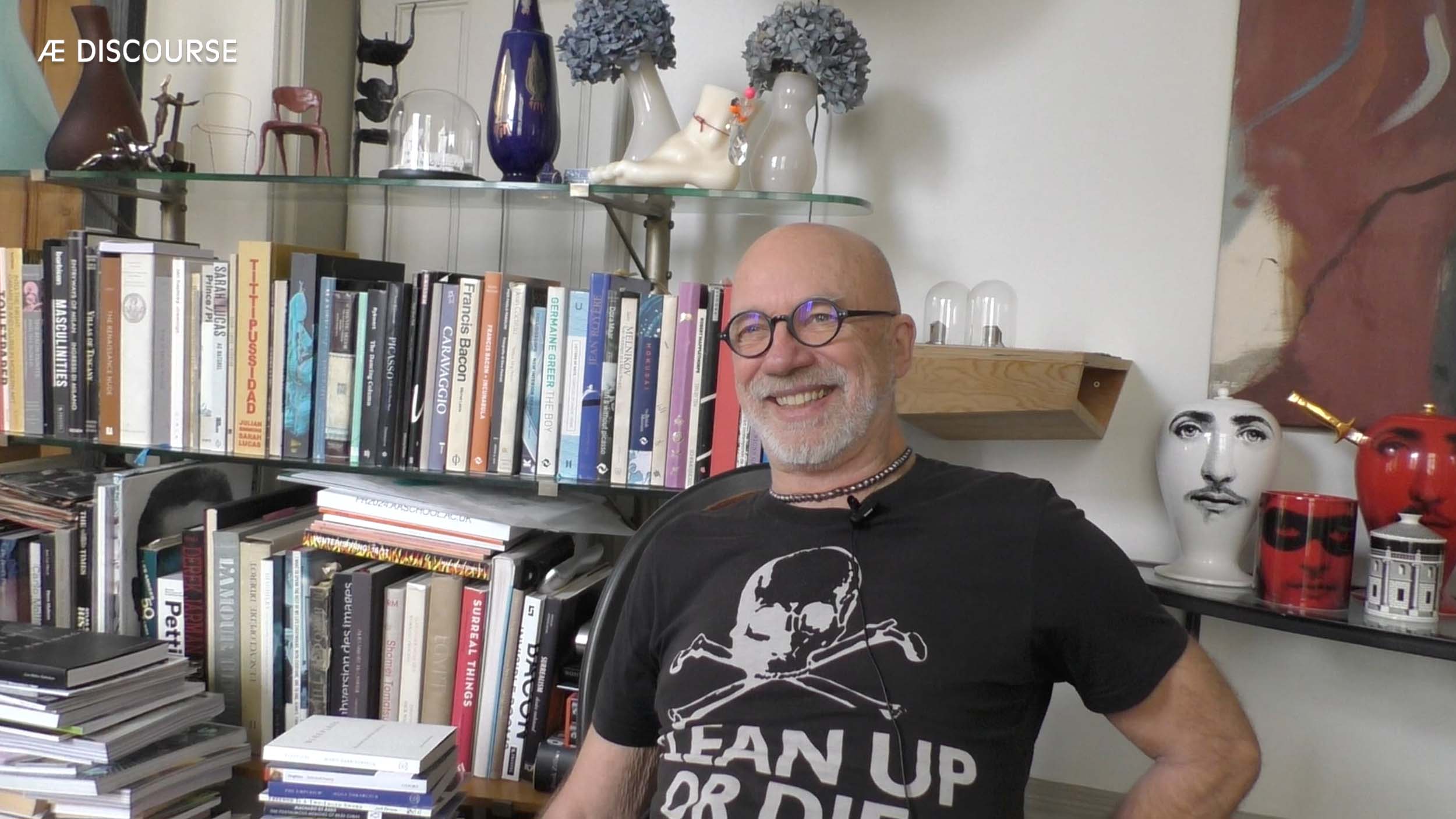
Mario Carpo
Biographical interview
SUMMARY
In this interview, Mario Carpo recalled his early skepticism toward computers. Influenced by Pasolini and communist politics, he initially rejected computing because he saw art as more political than science. Yet his architectural education in Florence fostered an interest in rules-based logic through semiotics. He analyzed architectural grammar and designed with variable arrangements of modular parts before turning to history. His research on images in architectural treatises led to a doctoral argument that reproducibility helped make architecture a modern profession. William Ivins’s ideas about images and modernity later informed Carpo’s Architecture in the Age of Printing.
While completing the book, Carpo encountered William Mitchell’s City of Bits, prompting him to consider how the internet might reverse reproducibility. During a 2001 fellowship at the Getty in Los Angeles, he met Greg Lynn, learned about mass customization, and began researching the history of digital tools in architecture. He also expressed concern about their use by large technology corporations and the long-term political implications of unreliable images and computation.
While completing the book, Carpo encountered William Mitchell’s City of Bits, prompting him to consider how the internet might reverse reproducibility. During a 2001 fellowship at the Getty in Los Angeles, he met Greg Lynn, learned about mass customization, and began researching the history of digital tools in architecture. He also expressed concern about their use by large technology corporations and the long-term political implications of unreliable images and computation.
BIOGRAPHY
After studying architecture and history in Italy, Mario Carpo was an assistant professor at the University of Geneva in Switzerland. Since 1993 he has been a tenured associate professor in France and more recently a professor at the Georgia Institute of Technology in Atlanta. Carpo has also taught at several distinguished universities in Europe and in the United States, including Cornell, the Massachusetts Institute of Technology, and Williams College, and has been a scholar in residence at the Getty Research Institute and at the American Academy in Rome. From 2002 to 2005 Carpo was the head of the Study Centre at the Canadian Centre for Architecture in Montreal.
CATALOGUE
INDEX
No tags assigned to this post.