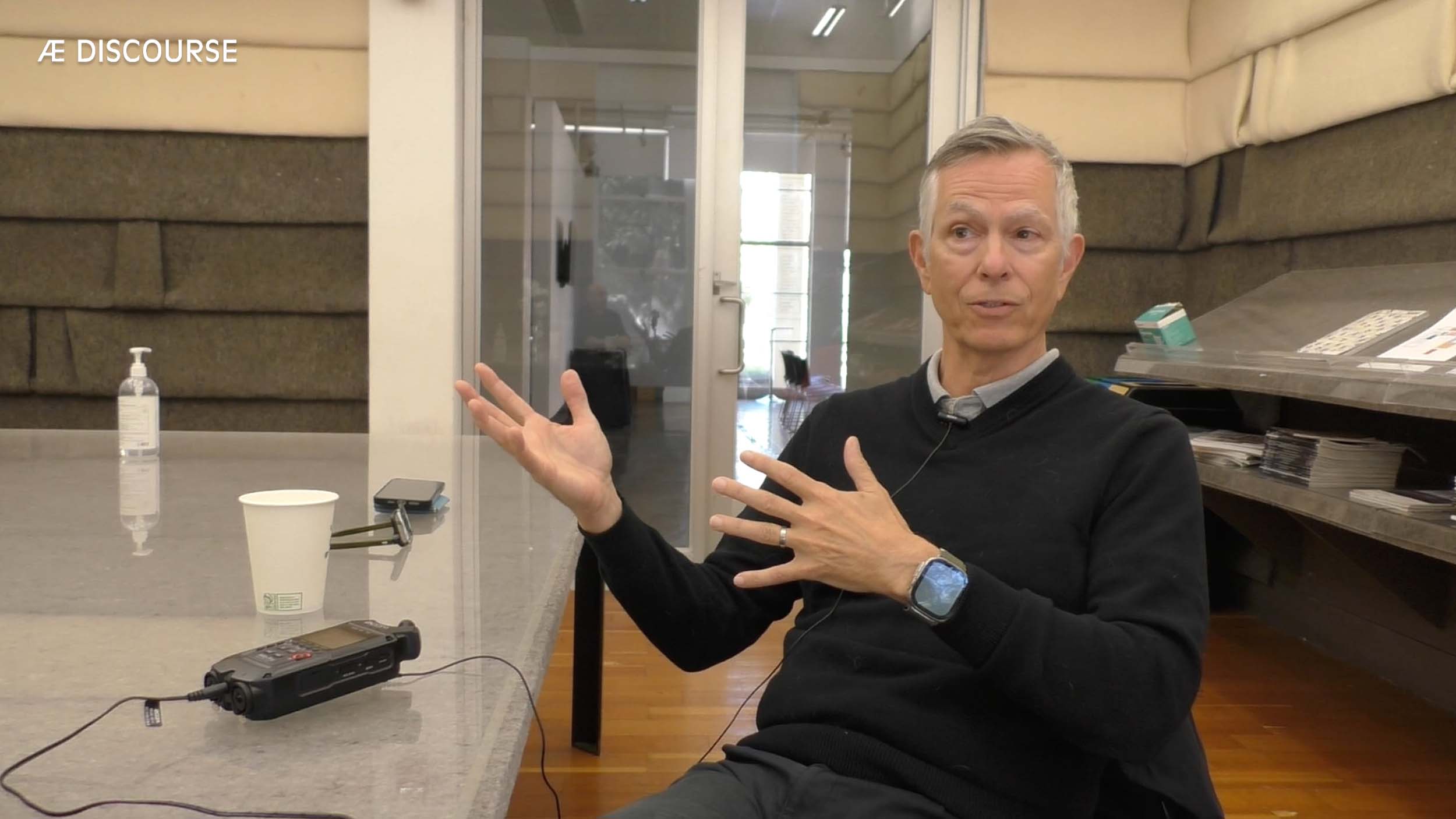
Andrew Zago
Biographical interview
SUMMARY
In this interview, Andrew Zago discussed his path from fine art to architecture. He studied color theory and Gestalt perception with Vincent Castagnacci and Rudolf Arnheim but initially found architectural education at the Harvard GSD disappointing. Encountering Cranbrook graduates who had studied under Daniel Libeskind, including Bahram Shirdel, introduced him to an artistic approach contrasting with Harvard’s professional orientation. Zago later established AKS RUNO in Los Angeles with Shirdel and Carl Chu. Modeled on Libeskind’s Intermundium, this hybrid school and office developed into a practice that included Jeff Kipnis before its members formed independent offices. As coordinator of Visual Studies at SCI-Arc, Zago worked with Anna Neimark on a curriculum addressing aesthetics, viewpoint, object perception, and color, reconnecting architecture with his artistic training. He also argued that craft alone could not produce meaningful architecture without engaging contemporaneity. His concept of “the awkward” proposed an authenticity that rejected nostalgia and moralism while embracing historical awareness and irony. It later became influential in the emergence of the post-digital, a term Zago recalled using around 2008.
BIOGRAPHY
Andrew Zago, AIA is principal of Zago Architecture. He received a Bachelor of Fine Arts from the University of Michigan and a Master of Architecture from Harvard University. From 2003–2007, he was the founding director of the Master of Architecture program at the City College of New York. He is also a Clinical Professor at the University of Illinois at Chicago and has taught at Cornell University, the University of Michigan, UCLA and the Ohio State University. Zago is a fellow of the American Academy in Rome and a member of the National Register of Peer Professionals of the General Services Administration in Washington.
CATALOGUE
INDEX
No tags assigned to this post.